
What Puerto Rican community organizations can teach nonprofit and public administration leaders about returning professional tools to community hands.
Across San Juan, Loiza, Carolina, and Vieques, I kept noticing the same quiet reversal. Skills institutions have used to explain, manage, study, or contain communities were being taken back by the people those institutions claimed to serve.
Communications became a tool for the visibility of Black Puerto Ricans. Archives became a form of repair. Public history interrupted colonial tourism. Agroecology became an argument for food sovereignty. Art, Bomba, farming, memory work, and facilitation were infrastructure for collective power.
That matters for nonprofits and associations because we talk constantly about capacity building. We fund training. We hire consultants to strengthen communications, evaluation, strategic planning, fundraising, board governance, and leadership development. Those tools can be useful. But the deeper question is: capacity for whom, and toward what kind of future?
This question is urgent now. In May 2026, the Puerto Rico Nonprofit Summit described more than 1,000 nonprofit leaders gathering for what it called the largest nonprofit event ever held in Puerto Rico and the Caribbean. National nonprofit research from the Center for Effective Philanthropy also shows leaders facing burnout, volatile funding, and intensified pressure on organizations serving communities pushed to the margins. Puerto Rican community organizations are offering something more demanding than resilience: self-determination.
The professional tools are not neutral
Public administration and nonprofit management often present professional disciplines as neutral. Communications is framed as messaging. Evaluation as measurement. Planning as alignment. Training as skill development. Archives as preservation.
But communities of color know that professional tools carry history. Communications has sanitized inequality and narrated communities through deficit. Planning has displaced neighborhoods in the name of progress. Research has extracted stories without returning power. Public agencies have used eligibility rules, case files, maps, and metrics to decide whose needs count and whose knowledge is anecdotal.
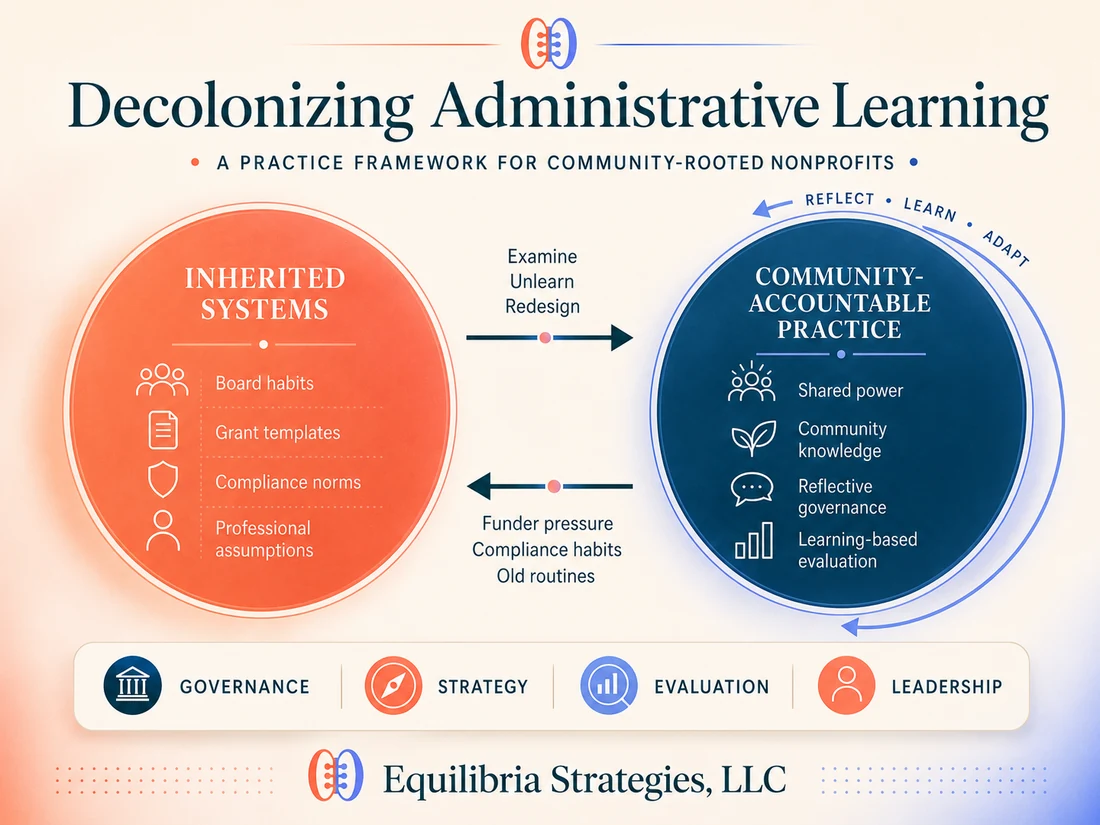
To decolonize a professional practice, then, cannot mean adding more inclusive language to the same operating system. It asks whether the tool itself is being returned to community purpose. Who defines the problem? Who controls the story? Who benefits from the training?
That is why the work I witnessed felt so instructive. Memoria Decolonial describes its detours as critical walking workshops that interrogate colonial legacies embedded in Puerto Rican heritage through decolonial, antiracist, and dialogical perspectives. That is public history as civic education. Archivo Negro presents Black Puerto Rican culture through images, archives, art, and testimony as a form of visibility and resistance. La Colmena Cimarrona in Vieques frames agroecology, solidarity economy, and beekeeping as food sovereignty across the Puerto Rican archipelago. That is agricultural training as governance, health, economy, and culture woven together.
Capacity building is a political choice
For nonprofit and association leaders, the lesson is not to copy these organizations or flatten them into a case study. The lesson is to examine the politics inside our own capacity-building language.
Many organizations are trained to become legible to funders before they are resourced to become accountable to community. They learn the grant vocabulary, the dashboard, the strategic plan, the board packet, the communications calendar. These are not bad tools. I use many of them. But when they become the center of organizational life, community knowledge can become background material. People become inputs. Culture becomes engagement. Survival becomes an outcome metric.
A decolonial approach asks us to reverse the order. The starting place is relationship, memory, land, language, body, grief, joy, and collective responsibility. Professional practice should strengthen those things, not translate them into something more comfortable for institutions.
That shift also changes leadership development. Leadership is more than individual confidence, charisma, or executive skill. It is the disciplined practice of returning tools to the people most affected by the decisions. It helps boards ask better questions about power, staff distinguish service from accountability, and funders understand that flexibility is often a condition for truthfulness.
What this means for strategy and governance
Puerto Rico also reminds us that governance is larger than bylaws. Community organizations govern when they preserve memory, train farmers, document Black cultural life, organize mutual aid, demand energy resilience, and create public spaces where people can name what has happened to them. In July 2026, community solar work in Culebra was announced for families relying on medical equipment, while disability-led and disability-supporting organizations continued calling for restoration of Puerto Rico Energy Resilience Fund residential solar and battery programs. These are governance questions about whose lives public systems are designed to protect.
For associations and nonprofits, this suggests a different strategic posture. Strategy should be less about producing certainty and more about building collective capacity to make meaning, make decisions, and act under unequal conditions. Equity has to show up in which skills are taught, which histories are centered, which communities own the narrative, and which measures are allowed to matter.
Questions leaders can take back to their own organizations
Which professional tools in our organization were inherited from systems that harmed, displaced, studied, or controlled the communities we serve?
Where are we building capacity for institutional approval instead of community power?
Who gets trained to speak, plan, evaluate, archive, facilitate, or govern - and who is still treated mainly as a participant?
What forms of knowledge do our board and funders recognize quickly, and what forms do they require communities to prove?
How would our strategy change if memory, culture, land, care, and self-determination were treated as infrastructure?
The most human part of this work is also strategic: people want the ability to tell the truth about their lives and shape their future. When professional training serves that purpose, it becomes more than technical assistance. It becomes a form of repair.
For those of us studying public administration, advising nonprofits, supporting associations, or sitting in governance rooms, Puerto Rico offers a challenge. We cannot decolonize public systems only by changing language at the top. We have to ask what happens to the tools themselves. Then we have to be brave enough to return them.
Sources Consulted
U.S. Department of Energy, Puerto Rico Energy Resilience Fund
Environmental Defense Fund, Culebra community solar initiative
The Partnership for Inclusive Disaster Strategies, call to restore Puerto Rico solar program
Written by Kelli Bohannon for The Work in Motion Blog.
Back to all reflections